

- 3 minutes
Recovery after a PRP injection: what to expect in the weeks ahead
Recovery, After Care & Rehabilitation
For many patients, a PRP injection is not the end of treatment. It marks the beginning of the next stage: recovery. After the injection, questions often arise. Can I return to sport straight away? Why do I have more pain for a while? When might I notice an improvement? And when should I contact an orthopedic specialist?
Recovery after a PRP injection differs from person to person. It depends on the condition being treated, the injection site, how severe and longstanding your symptoms are, and how much activity the affected area can tolerate.
In this article, you will learn what you may experience in the days and weeks after a PRP injection, what aftercare may involve, and which symptoms should prompt you to contact your treating doctor or orthopedic specialist.
Would you first like to learn more about the treatment itself? Read our guide to PRP injections in Amsterdam.
Recovery after a PRP injection: why does it take time?
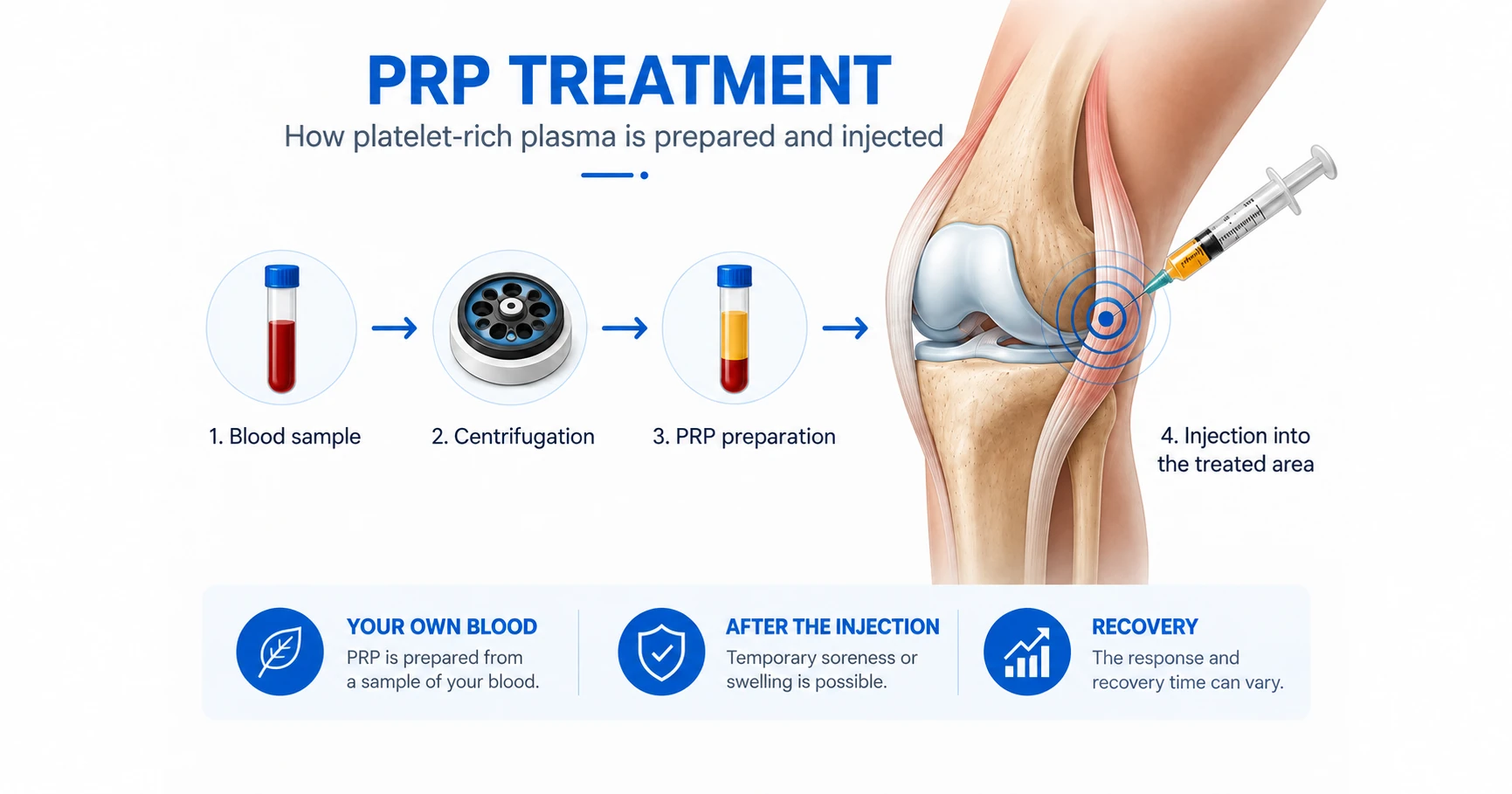
PRP stands for platelet-rich plasma: plasma with a higher concentration of platelets. During PRP treatment, a sample of your own blood is collected and processed. The resulting plasma is then injected into or around the area being treated.
Platelets contain biologically active substances and growth factors involved in processes such as tissue repair and the regulation of inflammation.
However, PRP should not be seen as a treatment that instantly repairs damaged tissue. The body needs time to respond, and recovery is complex. It differs from person to person and from one condition to another.
Research findings also vary according to how PRP is used. The composition of the PRP, platelet concentration, injection technique and condition being treated may all affect the outcome. For example, a systematic review of PRP for knee osteoarthritis found a small benefit compared with a saline injection at three and six months, but not at 12 months. The authors questioned how clinically meaningful that benefit was (Auroux et al., 2025). Findings for knee osteoarthritis cannot automatically be applied to other conditions.
It is therefore not possible to predict exactly when, or whether, you will notice an improvement.
The first few days after a PRP injection: temporary symptoms
You may experience some local symptoms in the first few days after treatment. This does not necessarily mean that something is wrong.
Possible reactions include:
- temporary pain at or around the injection site;
- a bruised or tender feeling;
- temporary stiffness;
- mild swelling; and
- a temporary increase in your existing pain.
The intensity and duration of these symptoms vary. Some people have little discomfort, while others feel noticeably more sore for several days.
A temporary reaction may be related to the injection itself and the local response of the treated tissue.
More pain after a PRP injection: is it normal?
A temporary increase in pain can occur after a PRP injection. If a tendon or another sensitive structure has been treated, the area may be particularly tender for a while.
However, do not assume that all pain is a normal part of recovery. How severe it is, whether it is getting worse and whether you have other symptoms are all important.
If the pain suddenly becomes severe, you feel unwell or you notice signs of infection, seek medical advice promptly. Dutch GP guidance advises contacting a doctor if an injection site becomes increasingly red, warm or swollen, the pain worsens, or you develop a fever or feel unwell (Thuisarts). That guidance discusses injections in general and mainly describes corticosteroid injections; your own PRP aftercare instructions remain important.
Further down, we explain when to contact a doctor or orthopedic specialist.
PRP injection aftercare: what can you do?
Appropriate aftercare depends on the area treated and the condition for which you received the injection.
There is no single recovery program that suits every PRP treatment.
Your treating clinician may give you specific instructions about how much activity the affected area can tolerate. Always follow that personal advice over general information.
Early recovery: avoid overloading the area
Immediately after a PRP injection, it is generally sensible to avoid unnecessary heavy loading of the treated area.
That does not always mean complete rest.
For many muscle, tendon and joint problems, a gradual, controlled return to movement and activity is part of recovery. What you can do depends in part on the structure that was treated.
For example, an activity plan following an injection for a tendon problem may differ from the plan after an injection into a joint.
Until you have discussed your plan with your clinician, avoid rushing back into:
- intensive sport;
- heavy strength training;
- explosive movements;
- activities that clearly aggravate your pain; and
- your previous full training load.
If you are unsure about a particular activity, discuss it with your treating clinician or physiotherapist.
When can you return to work after a PRP injection?
Whether you can return to work straight away depends on your job and the injection site. A relatively quick return to light or desk-based work may be possible, depending on your symptoms and your clinician’s advice.
If your work is physically demanding and involves frequent lifting, walking, kneeling or repetitive force, temporary adjustments may be appropriate. Returning to heavy activity too soon can unnecessarily overload the treated area.
If in doubt, discuss the demands of your work with your clinician.
When can you return to sport after a PRP injection?
For many people who exercise or play sport, this is one of the main questions.
A PRP injection does not mean that everyone can return to full training after a fixed number of days. The plan should take into account:
- the original injury or condition;
- the body part treated;
- how severe and longstanding your symptoms are;
- your response to treatment;
- the demands of your sport; and
- your progress in strength and tolerance of activity.
For example, a footballer with a longstanding tendon problem may need a different recovery plan from someone who received PRP for a joint condition.
A gradual return is important
For many orthopedic and sports-related conditions, prolonged complete rest is not necessarily the best approach.
The affected area needs to regain the ability to tolerate activity. Depending on the condition, a gradual plan may include:
- returning to comfortable daily activities;
- gentle movement and therapeutic exercises;
- progressive strengthening;
- sport-specific activity; and
- a gradual return to full training.
The pace of these steps differs from person to person.
Pain is only one aspect of recovery. Strength, stability, movement control and the ability to tolerate load may also matter before a full return to sport.
Physiotherapy after a PRP injection: the role of rehabilitation
A PRP injection is often one part of a broader treatment plan. Depending on your condition, physiotherapy may play an important role.
The injection does not replace a suitable rehabilitation program when strength, stability, mobility or tolerance of activity are part of the problem.
A physiotherapist can help you:
- build up activity gradually;
- improve muscle strength;
- work on stability and coordination;
- adapt movements that trigger symptoms; and
- return to sport in a controlled way.
The rehabilitation program should match your diagnosis. A tendon problem, for example, may require a different approach to loading from a joint condition.
How long does it take for a PRP injection to have an effect?
There is no exact answer that applies to every patient.
The outcome of a PRP injection cannot usually be judged immediately after treatment. Any changes in pain and function may develop over a longer period.
Some people notice a gradual change within the first few weeks. For others, it takes longer, and some may not benefit. It is also useful to distinguish between:
- temporary changes in pain;
- an improvement in daily activities;
- greater tolerance of activity; and
- a lasting improvement over time.
Feeling better for a short time does not necessarily mean that recovery is complete. Equally, a lack of immediate improvement does not settle the longer-term outcome.
The result is best assessed in relation to your original symptoms and the rest of your treatment plan.
A possible recovery pattern after PRP
Although every recovery is different, the period after an injection may broadly look like this:
The first few days
Local pain, tenderness or temporary stiffness may occur. Heavy loading of the treated area is generally limited.
The first few weeks
The initial reaction often gradually settles. Depending on the condition, gentle movement or a guided exercise program may be introduced or increased.
The following weeks
You and your clinician can assess how the area responds as activity increases. Any improvement may develop gradually.
Longer term
The outcome depends on more than the injection alone. The original condition, your general health, how the treated area is used and your rehabilitation plan may all play a role. There is no universal timeline.
Pain relief and medication after a PRP injection
Use medication after a PRP injection according to your treating clinician’s advice. This is particularly important if you use, or are considering, anti-inflammatory painkillers.
Non-steroidal anti-inflammatory drugs (NSAIDs), such as ibuprofen, naproxen and diclofenac, affect inflammatory processes and platelet function. It is not fully clear what this means for the clinical effect of PRP. Advice on temporarily avoiding NSAIDs therefore varies between clinics, indications and treatment protocols.
Never stop a prescribed medicine without first speaking to your doctor.
If you have pain after treatment, ask your clinician which pain relief is appropriate for you. Paracetamol is often the first option mentioned in general Dutch patient information about pain relief, but the correct dose and whether it is suitable for you depend on your health and other medicines. In some countries, paracetamol is called acetaminophen.
Should you use an ice pack after a PRP injection?
Some people find that brief cooling eases local discomfort.
Whether it is recommended in your situation depends on the area treated and your clinician’s instructions.
Avoid prolonged or intensive cooling unless your treating clinician has advised it. Follow the personal instructions you have been given.
When should you contact a doctor after a PRP injection?
Some local pain or tenderness can occur after a PRP injection.
However, contact your treating team or GP if:
- the pain is severe or clearly continues to get worse;
- your symptoms differ from what your aftercare instructions led you to expect;
- redness or warmth around the injection site is increasing;
- swelling becomes noticeably worse;
- you develop a fever or feel generally unwell;
- fluid, pus or other discharge comes from the injection site;
- you develop new or increasing numbness or weakness; or
- you are concerned about how your recovery is going.
Seek prompt medical advice if worsening pain is accompanied by increasing redness, warmth, swelling, fever or a feeling of illness. If your treating team is unavailable, contact your GP or the out-of-hours GP service (huisartsenpost). These symptoms do not necessarily mean there is a complication, but they may need assessment.
When is a follow-up appointment useful?
A review may be helpful even when there is no urgent complication.
For example, consider a follow-up if:
- your symptoms do not improve over time;
- your original symptoms become noticeably worse;
- you are not making enough progress in daily activities;
- you cannot return to work or sport;
- there are doubts about the original diagnosis; or
- you have questions about the next treatment step.
A PRP injection is one part of a broader medical picture.
If treatment has not helped enough, it is important to reconsider what may be causing the symptoms and which next step is appropriate.
That does not automatically mean another PRP injection is needed. Further investigation, an adjustment to rehabilitation or a different treatment may be more suitable.
Why does recovery after PRP vary between people?
Two people can receive a similar treatment and still recover differently. Factors that may play a role include:
- the exact diagnosis;
- how long symptoms have been present;
- the extent of the tissue problem;
- the treatment site;
- age and general health;
- daily and sporting demands;
- the way rehabilitation is built up; and
- differences between PRP preparations.
PRP is not prepared or applied in exactly the same way in every study. Research findings therefore also differ, and individual outcomes cannot be guaranteed.
A clear diagnosis and a suitable treatment plan remain the basis of responsible orthopedic care.
PRP treatment and your next steps
Have you had a PRP injection and are unsure about your recovery? Or do you have longstanding tendon, muscle or joint symptoms and want to know whether PRP might be considered? At Orthopedic Care Clinics, we look beyond the injection itself: your symptoms, diagnosis, daily activities and possible next steps all matter.
An orthopedic specialist can assess which options may suit your situation. If you would like to discuss PRP treatment, contact Orthopedic Care Clinics.
If you have persistent or recurring symptoms, you can also arrange an orthopedic assessment. For a specialist appointment, the clinic asks for a referral from your GP or another specialist.
PRP injection or hyaluronic acid?
PRP is not the only injection treatment that may be considered for certain orthopedic conditions. For joint symptoms, particularly some forms of osteoarthritis, hyaluronic acid may also be discussed. When might PRP be considered, and when might hyaluronic acid be an option?
We explore this in our related article, PRP or hyaluronic acid: when is each treatment considered? It looks at how the treatments differ, where they may be used and which factors can influence the decision.
Frequently asked questions about recovery after a PRP injection
How long will I have pain after a PRP injection?
Temporary pain or tenderness can occur after a PRP injection. How long it lasts varies from person to person and depends on the area treated. Contact your treating clinician if the pain is severe, clearly getting worse or causing you concern.
Can I move around immediately after a PRP injection?
That depends on the injection site and your personal circumstances. Gentle movement may be suitable in some cases, while certain activities may need to be limited temporarily. Always follow the instructions from your treating clinician.
When can I return to sport after a PRP injection?
There is no fixed timeline that applies to everyone. Your return to sport depends on your diagnosis, the area treated and how your recovery progresses. A gradual increase in activity is often important.
Why do I have more pain after my PRP injection?
The injection itself and the local response of the treated area may cause a temporary increase in pain. Severe, worsening or unusual pain should be assessed by a clinician.
How soon might I notice a change after a PRP injection?
The outcome usually cannot be assessed immediately after the injection. Any changes in pain or function may develop gradually. The timing and degree of change vary between people and conditions.
Do I need to rest after a PRP injection?
Heavy activity is often limited temporarily, but complete rest is not always necessary. The right level of activity depends on your diagnosis and the area treated. Ask your treating clinician what is appropriate for you.
When should I contact my doctor after a PRP injection?
Seek medical advice if you have severe or increasing pain, worsening redness, warmth or swelling, a fever, feel unwell, notice discharge from the injection site or have other symptoms that concern you.
Is one PRP injection always enough?
Not always. This depends on the condition, the treatment plan and your response. Another injection should only be considered if there is a medical reason for it in your individual situation.
Can I book an appointment with Orthopedic Care Clinics for persistent symptoms?
Yes. If you have ongoing joint, muscle or tendon symptoms, an orthopedic specialist can assess your situation and discuss possible next steps. A referral from your GP or another specialist is required for an appointment.
Sources
Auroux, M., Debionne, T., Mainbourg, S., & Chapurlat, R. (2025). Efficacy of intra-articular platelet-rich plasma compared with placebo in knee osteoarthritis: A systematic review and meta-analysis. Joint Bone Spine, 92(6), 105947. https://pubmed.ncbi.nlm.nih.gov/40653151/Thuisarts.nl. (n.d.). I want to take a painkiller (aged 18 and over) [in Dutch]. https://www.thuisarts.nl/pijn-en-pijnstillers/ik-wil-pijnstiller-gebruiken-vanaf-18-jaar
Please contact us to schedule an appointment.